A Narrow Front Three or a Wide One? Reading the Trade-Off
A narrow or wide front three changes who can receive between the lines and which defenders must leave their positions. Read the matchup with clearer cues.
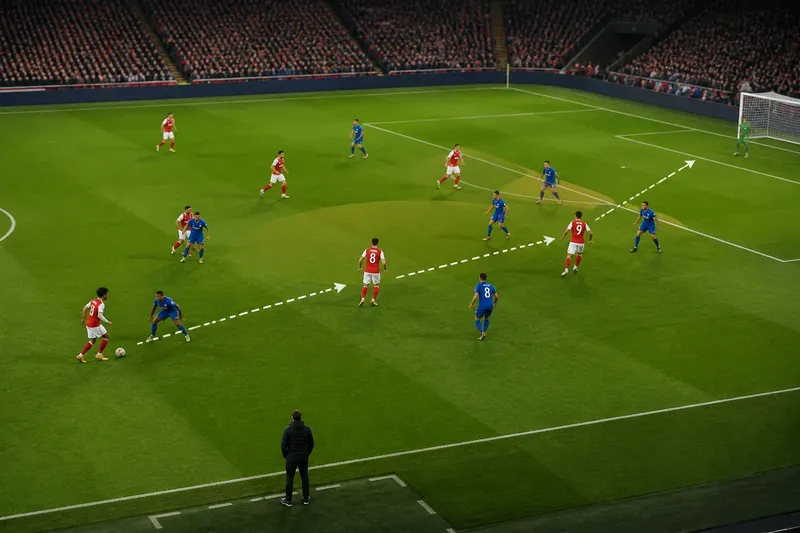
A narrow or wide front three changes who can receive between the lines and which defenders must leave their positions. In a match preview, that spacing is most revealing when it is tied to one opponent’s defensive habit: does the back line track runners, or protect its positions and pass them on?
Rather than treating width as a general virtue, look for the particular defender the attackers want to move. A winger can pin a full-back outside; an inside forward can draw a centre-back towards the channel. The useful question is what that movement opens for the next player.
Front-three spacing
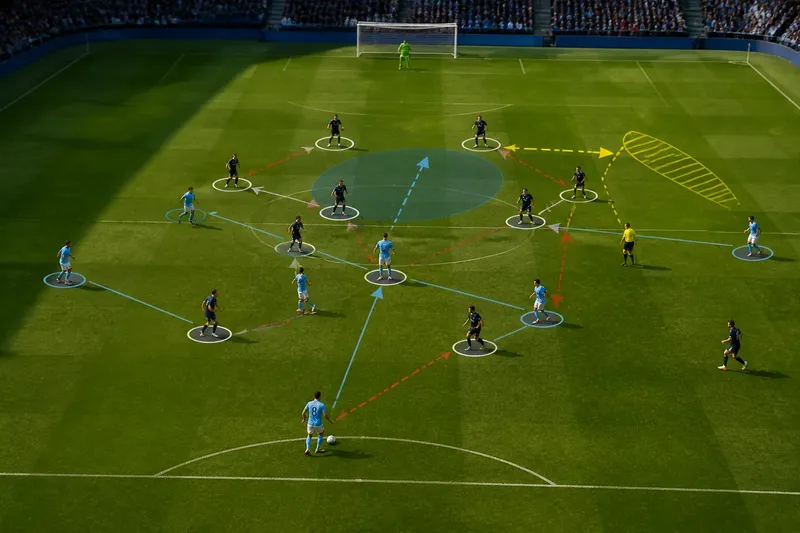
A narrow front three places its wide forwards closer to the centre-forward, often in the half-spaces between the middle and the flanks. A wide front three holds those forwards nearer the touchlines. Neither description fixes their positions for an entire attack: the relevant clue is where they settle when the ball reaches the final third.
The arrangement also depends on the players behind the front line. Full-backs may provide the width for narrow forwards, while midfielders connect wide attackers to the centre. If those supporting runs do not arrive, the spacing on paper may not produce a useful route to goal.
Who gets pulled out?
The most specific tactical question is which defender has to leave a preferred position. Against a wide forward, the opposing full-back may step towards the touchline, opening the channel inside. Against a narrow forward, a midfielder may be drawn deeper or a centre-back may have to decide whether to follow a runner into the half-space.
That decision matters only if another attacker can exploit the space. A run between full-back and centre-back can punish a defender who steps out; a pass behind the full-back can target the space left by an advance. Without a timely runner or pass, the opponent can adjust and retain its shape.
Defenders may also avoid the apparent dilemma. A full-back can press the winger while a midfielder covers inside, or a centre-back can hold position and let a teammate track the run. In a preview, identify the likely cover player as well as the defender initially drawn towards the ball.
Central combinations
Narrow forwards can provide short diagonal options for a midfielder receiving between the opponent’s lines. A centre-forward might set the ball back, while a wide forward runs beyond or across a defender. This can put several attackers close enough to combine, but only if their movements occupy different lanes.
If the forwards stand on the same line or drift into one another’s path, a screening midfielder may block the route to all of them. The opponent can then keep its centre-backs close and invite play outside. The distinction is not simply crowded versus open: it is whether each attacker makes a separate defender choose.
Wide duels
Wide forwards can make an opposing full-back defend facing their own goal, especially when the pass arrives early enough for the winger to turn. A supporting full-back can overlap outside or underlap into the channel. Those runs matter because they give the winger an alternative to taking on a defender alone.
The cost is distance from central support. If a winger receives near the line with teammates behind the ball, the opponent can show them towards the boundary and wait for help to arrive. A switch to the far side can be useful, but the recipient still needs time and a teammate close enough to support the next action.
Matchup questions?
When does a narrow front three help?
It can help when a midfielder can receive between the lines and the forwards occupy separate central lanes. If the opponent protects that area with a compact midfield, the attack may need a full-back to provide width and shift the block.
When can wide forwards isolate a full-back?
They are more likely to do so when the ball reaches them before the defence has shifted across. Check whether a nearby midfielder or overlapping full-back can support the duel; without that help, the winger may be forced towards the touchline.
What should a preview say about the opposing full-backs?
Note whether they step forward to press, hold a deeper line, or receive cover from a midfielder. That habit helps identify whether the likely opening lies behind them, inside them, or not at all without a supporting run.
Reading the matchup
Before kick-off, connect the expected front-three spacing to a named defensive response. If the opponent’s full-backs press aggressively, consider whether a forward can run into the space behind them. If its midfield screens central passes, ask whether the wide players can draw that screen across and whether the far side can then be reached.
- Observe whether a winger receives facing forward; if so, expect the full-back to engage and check for a supporting run inside. If not, look for a short return pass or a switch away from pressure.
- Observe whether the near midfielder stays available beside the winger; if so, the pair can attempt a combination. If not, look for a deeper pass to reset rather than an unsupported dribble.
- Observe whether the full-back overlaps or underlaps; if so, identify which defender must track that run. If neither run comes, expect the winger to remain the main wide outlet.
- Observe whether the opponent’s midfield shifts towards the ball; if so, check whether the far-side forward is free. If it holds its shape, look for a central pass or a run between the lines instead.
- Observe whether a runner enters the channel between full-back and centre-back; if so, note whether a defender follows. If no runner appears, the defence can stay compact and protect the box.
- Observe whether the centre-forward pins both centre-backs; if so, an inside forward may find room to arrive beyond. If the striker drops away, check whether another attacker takes up the central threat.
Say a team expects the opposing right-back to step out whenever a winger receives. Its left winger starts wide, the left-back stays behind the ball, and a midfielder is ready to pass into the inside channel. The preview’s working expectation is that, if the right-back presses and the right centre-back holds, the midfielder can find a runner behind the full-back; if the centre-back follows that runner, the striker may gain room centrally. If the right-back stays deep instead, the winger is more likely to face a defender in front and the attack may need a supporting overlap. Each outcome points to a different next action, rather than proving one shape superior.
Player roles
A winger who can receive under pressure and combine quickly may suit an inside position, while a player who can carry at a defender may be more useful holding the touchline. These qualities can overlap. The opponent’s full-back, the distance to support and the location of the next pass all affect the role.
The centre-forward changes the relationship too. A striker who pins the centre-backs can leave room for inside runners. One who drops towards midfield may help link narrow combinations, but another attacker then needs to threaten the space in front of goal. With wide forwards, a striker moving towards one flank can free the far-side attacker to enter the box.
Mixed spacing
Teams can hold one winger wide and bring the other inside, giving each side a different task. The wide player can pin a full-back; the inside forward can attack the gap that defender helps protect. A full-back may overlap on one side and remain deeper on the other, changing the routes available without changing the front three.
For a match preview, state the likely assignment and the defensive response that would make it useful. A narrow front three directs attention to central lanes and the defender asked to track an inside run. A wide one directs attention to the full-back’s duel and the cover behind it. The best cue is not the team’s formation label but whether the next attacker can use the space a defender has just vacated.