From Fixture List to Matchday: What Context Can Tell You
Fixture-list context sharpens a football preview by linking nearby games to selection and preparation questions, without treating the calendar as a prediction.
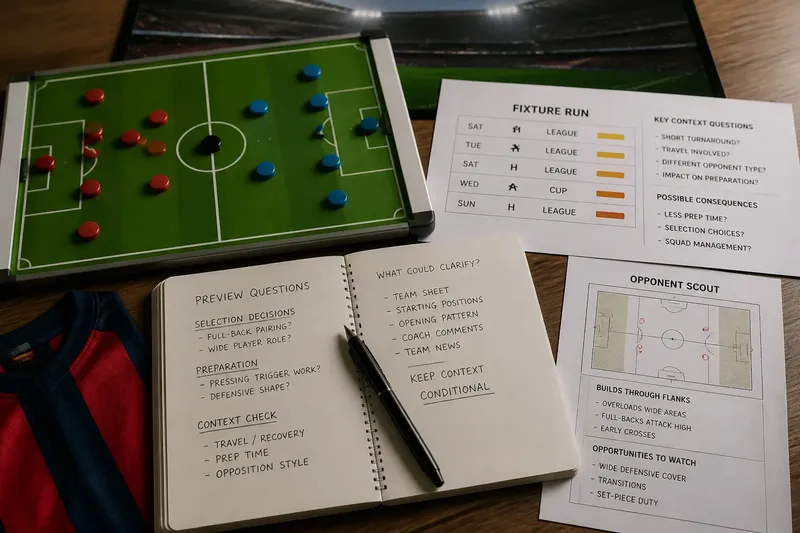
Fixture-list context is useful when it points to a specific matchday decision, not when it simply labels a run of games as demanding. A nearby away trip or cup tie may raise questions about preparation, selection or tactical roles, but the calendar alone cannot answer them.
The strongest preview connects the schedule to something visible: the team sheet, a player’s role or the way a side begins its pressing. That keeps context informative without turning a possible influence into a claim about fatigue, rotation or intent.
Read the schedule carefully
Start with the fixtures immediately before and after the match. Note where they are played, how much preparation time sits between them and whether the team faces a different kind of opponent. Then ask what practical issue those details might raise.
A quick return from an away match could leave less time for tactical preparation. A demanding previous game might make continuity and fresh options relevant. Neither point establishes that the squad is tired or that the coach plans changes. For that, look for current team news, recent selection choices or public comments.
Time between fixtures is only part of the picture. Two teams with a similar gap may have different travel and training circumstances. Describe those conditions plainly, and avoid turning them into a judgement about how well either side will perform.
Choose a useful lens
A short calendar note is enough when the schedule supplies background but no clear sign of a change in approach. Mention the nearby fixture, then state the question it raises. Do not imply that a future match will take priority unless there is evidence to support that reading.
A preparation comparison suits a preview centred on organisation. If one side has had a different window to work on a coordinated press or a defensive pairing, the contrast may be relevant. It still does not reveal what happened in training or how well a plan will work.
An options lens is useful when schedule context overlaps with a real selection question. Consider whether a coach can replace a wide player without changing the pressing shape, or whether a different full-back pairing would alter the team’s width and cover. Keep the tactical effect conditional until the team sheet confirms who starts.
Connect context to evidence
Before including a schedule point, complete this sentence: “The fixture list matters because it may affect…” A specific ending—such as the available full-back pairing or time to rehearse a pressing trigger—gives the detail a clear purpose. If the sentence ends with a broad claim about motivation or tiredness, the calendar is not enough to support it.
Say a team played away in midweek and now faces an opponent that builds through the flanks. The coach has recently used two different full-back combinations, but there is no confirmed team news. The preview can identify the pairing as a decision to watch, then explain that one combination may offer more width while the other may provide different defensive cover. On matchday, the team sheet will show the selection, and the players’ starting positions will show how the choice is being used. The schedule may be relevant, but it cannot establish why the coach chose that pairing.
- If the team sheet confirms a changed full-back pairing, describe the roles those players take; if it does not, focus on the established combination instead.
- If public comments identify a preparation concern, explain the tactical task it affects; if they do not, keep the schedule point conditional.
- If the previous match involved a long away journey, mention the travel as context; if the route is not known, do not infer its burden.
- If a nearby fixture makes a squad option relevant, name the position and possible replacement; if no credible alternative is apparent, leave rotation out.
- If the preview concerns a rehearsed press, compare the teams’ available preparation windows; if that link is unclear, use a simple calendar note.
- If the opening phase shows a different pressing shape, describe the observed change; if the side uses its usual approach, do not attribute that pattern to the schedule.
What does the schedule tell you?
Does short rest mean rotation?
No. It makes rotation a possibility, but availability, tactical needs and the coach’s preferences also shape selection. Identify the decision to watch rather than presenting a change as settled.
Can the next opponent affect this match?
It may influence squad management, but the fixture list cannot show that the next game is being prioritised. Look for supporting signs, such as selection patterns or relevant comments, and keep the connection conditional.
How should travel appear in a preview?
Name the journey only when it raises a practical question about preparation or recovery. Do not translate travel into a claim about fatigue without information about the team’s circumstances.
When should schedule context be left out?
Leave it out when it adds no distinct question about availability, preparation or tactics. Nearby fixtures are not analysis by themselves; each detail should help readers understand what to watch.
Keep context in proportion
Schedule context does not replace analysis of team shape or the matchup. A congested run does not automatically explain a low block, and a longer break does not prove a side will press higher. The opponent, available players and the coach’s preferred plan matter too.
Separate what is known from what is inferred. State the fixture sequence, identify the possible consequence and say what could clarify it. The team sheet may reveal whether a player is rested; the opening phase may show whether the side uses its usual pressing shape. Treat those observations as evidence about this match, not as a complete explanation of the schedule’s influence.
Fixture-list context earns space when it sharpens attention on a real decision. Used carefully, it tells readers what to watch for in the selection and the opening pattern of play, while leaving the coach’s reasons and the match’s outcome open.